Beep Beep...robots
Being human is a given. But keeping our humanity is a choice.
-unknown
Part 1- Sept 2018
What is there to fear? We fear what we don't know. We fear that we will be replaced.
As a human being, we pride ourselves on our intelligence. The world we built made us feel we are invincible compared to other animals. We tell ourselves the story that we are unique. Stories, games that we make to make ourselves feel clever. As a plot of a movie unfolds, how many of us believe we know the ending of the story or who the unknown villain could be? Stories repeat themselves, patterns that we have seen in the past already tell us most of the options of the ending of the story. A machine, an algorithm can process these patterns quicker than we can.
To know that something could do what we do in a fraction of the time and better would scare many of us. Forty-hour work weeks, years of being called the expert, now a machine is the expert. Many of us would like to believe that our job title does not define us but it is how society values us. Our value is base on what we know; it is why education became an investment for many, the endgame to most with schooling is to get a job. Isn't that why many people want their child to get a degree?
If AI can do what we do more efficient and cost efficient is it wrong to be replaced by them? The idea that humans are special is embedded into our heads from a young age. Maybe to those who love us we are one of a kind. But with over seven billion humans, are we snowflakes? Fight club Tyler Durden said, "You are not special. You are not a beautiful or unique snowflake. You are the same decaying organic matter as everything else." We are replaceable in many work environments and this world.
The shattering statistic and number game we play. Only x amount of people make this much. Schools chuckling and pleased at their "You should be proud you are only of 10% that got in who applied" Extraordinary? No.
Maybe it's the beast, the animal in us that unconsciously we made a world that is survival of the fittest against each other. Yes, we have structure, there is some order in the chaos. A financial system we made, putting values on humans. Houses, education, brand name handbags to show off our social status. What is the purpose of money? It seems it's to segregate humans. Communities divided by prestigious school districts. Prices of homes segregated. Physically a house is a shelter, but we made it into a competition, capital gains. It is a business of supply and demand. A basic need that has now become a luxury. Cruelty disguised as civility. Are we any better than other animals? We found ways to live longer yet access to care to live depends on our geography, age, employment, and bank account. Is it intelligence or manipulation of the basic needs of living?
Many humans believe in equality and helping others. The question is how do we help others? Giving someone food but not teaching them how to grow food, is it giving? We are making others rely on us. Giving someone medicine, but not showing them why they need the medication, who are we helping? Is it better to provide and give something rather than do nothing? Yes, but should we not think about making it sustainable? To empower the people not to enable the people?
The answer to empowering others lies in AI. What if AI can make us more caring and giving? More independent from this world of capitalism and consumerism. Yes, buying things stimulate the economy, but who is winning? Tyler Durden said, "We're consumers. We are the byproducts of a lifestyle obsession." The person winning is not the consumer. It is an addiction.
Monetary gains drive us. What we need is a choice, where we don't have to play this monopoly game that someone dictated the rules centuries ago. We have been relying too much on corporations and third parties. We made up laws and businesses to take advantage of humans. It is almost like a pyramid scheme.
Some worry about the hackable state of AI, like any other software, yes it is hackable. But, I ask you are we not hackable? Tyler Durden, although a fictional character, was written by a human, therefore his outlook on this world came from humans. He said, "Advertising has us chasing cars and clothes, working jobs we hate so we can buy shit we don't need." Advertising, marketing, PR, all ways to hack into our minds. Fight Club raised the question does the content we own make us who we are? Although the movie was before social media, the same rhetoric can be used to ask the question, "Is the content of our Instagram, Facebook, Twitter, and other social media makes us who we are??" The likes, the hearts, the comments, when we login to our account. Data. Data being used to advertise to us. Does it work? Why do people spend so much money on advertising and marketing? Because we are hackable, we are predictable. These apps, know where we are, what we like, our browsing history, how we type/write, our connections, among other things. Algorithms to predict what we may like fed into our feeds. We all want to believe that the content we post up, own, read does not make us who we are, it shouldn't. Does a picture tell a story? Why are there influencers? Because we are easily influenced by what we see, read, hear. We are products to these companies. Those who can make monetary gains of this, we call geniuses. "Once an idea exists, it cannot be killed." What does this mean in regards to social media? Something disguised as fun and entertaining can turn into propaganda. A number game of followers. Virality.
Is AI bias? Of course. Who is writing these algorithms? Where are these data coming from and how are they collected? Humans. Tribalism. From a young age, humans are more apt to be drawn to people who look like them. As we age, we are more prone to be attracted to those who think like us. We like to feel relatable. Jocks vs. Nerds, Republicans vs. Democrats. Movies, stories are written to have a character we can all identify to, this is why public figures have a publicist. Our identity makes all of our bias.
Humans vs. Robots? Why must we play the story like this? Why can't we co-exist? Robots are not trying to be human; it is more like humans are trying to be robots. A robot is mechanical. We, on the hand, are made of flesh meaning to sustain life our cells have to regenerate regularly to remain functional. Eventually, it can't do its job correctly. Replacing our natural eye lens, hips, knees, heart among other organs. Plastic surgery and cosmetics can make us look like a perfect digital avatar. Physically it seems, we want to be robots. Even our brain, a mind blogging organ, absolutely stunning, we want to change it because it cannot keep up with a computer? Our biggest fear is robots taking over the world, so our solution is to be more like a machine? Logical, smart? Maybe.
We have trust issues. We don't want to be replaced by a machine, yet most of us are on a web browser GOOGLING for answers. Empathy, a great trait humans have. No one wants to see someone else losing their jobs to machines, yet we are the direct reason people are losing their jobs. We want things faster, cheaper, more convenient. Answers about our health, templates for things such as making manuals, instructions, websites, forms, accounting, DIY for many things easily accessible on the world wide web. We seek answers online, but when we say a healthcare practitioner is replaceable by a machine that has the same knowledge/data as a health care provider, not from a search engine, we go berserks. We start defending for our existence, not what is for the greater good. Remembering that there are billions of humans that access to care is scarce in developing part of the world and in some rural areas in America, we make laws and regulation to benefit multiple industries, to hinderance care.
There is internal medicine, family medicine, nurse practitioners, physician assistants, whose jobs are all very similar, supposedly to give access to more people. We keep expanding boundaries, more schools open, boards and associations that make money out of all of this, yet we still have the same problems, access to care is still a barrier. It is not working the current strategy. Why can't we have a choice for a personal health assistant instead of GOOGLING our health problems? If we care about other's welfare, why are we fighting to make laws and regulation that benefit only those who can make the most monetary gains? Are we protecting others or are we preserving our existence, our value? Some humans believe that the greatest criminals are the ones who know the laws well. Is that why we have lobbyists? The best disguise is to hide in plain sight?
Autonomous cars, hackable right? If there is a program running it, there is a possibility of being hacked, that is a given. But what makes Autonomous vehicle dangerous when it's hack? It is not the AI component of it. It is the simple fact that automobiles are made of explosive, combustible elements. The velocity of a vehicle makes it more dangerous. If humans are hackable, that propaganda can occur with social media, is it not possible also that humans can use automobiles as a weapon? The solution it seems is to make a form of transportation that does not involve highly flammable and explosive parts.
The truth is, many of us don't want to hear the truth. Out of sight, out of mind. We see, but we don't observe. Things are working okay for most of us. Is, "Okay" what we want because we don't want to rock the boat? The world is changing. Globalization, climate change, world population increasing, and resources will eventually run low. Maybe not in our lifetime but our humanity won't stand a chance if we keep doing what we are doing. If we are trying to save our humanity, we should not be afraid of AI. Humans use machines as power. AI is knowledge. Knowledge is power. Power is greed. We should all rethink why we have a negative view with robots. It is our lack of trust in each other that makes AI dangerous. With AI we can share what we know, spread the wealth? Robots do not have to be our enemy.
To see:
To read:
- Microsoft A.I can code your website from freehand sketch
- Deepmind's AI can detect over 50 eye diseases as accurately as a doctor
- Google AI tool identifies a Tumor's mutation from an image.
To hear:
Part 2- Oct 2026
"Everything here wants to kill you. I mean, look at the dirt! It's full of microbes that want to eat your eyeballs!"
-Albert, A Million Ways to Die in the West
Progress. Benefit. Is there more good than harm? At what cost?
Every part of AI carries a risk like many of its predecessors.
Every risk started when we began to digitize our lives. The benefit was that information could outlive us. A photograph could outlive a memory. A video could outlive a voice. A digital archive could outlive a library.
Technology solved the problem of preservation, but every solution changes us.
The risk was not that we would lose information. The risk was that we would change our relationship with information.
When information was difficult to preserve, people had to develop skills to create and remember it. To preserve an image, someone learned to paint. To preserve a story, someone memorized it. To preserve knowledge, someone copied books by hand.
Technology's purpose is to preserve and distribute information across time. Its greatest achievement is turning the privileges of the few into possibilities for the many. Its greatest risk is not replacing human skill, but making it easy to forget why that skill mattered in the first place.
Before photography, a painted portrait was a privilege. It was for those from wealth, then their face, their family, their achievements could be remembered for generations. If we were poor, we might leave behind almost no visual record of your existence. What was once reserved for kings, nobles, merchants, and aristocrats became available to ordinary people. Photography changed that, then inexpensive cameras, then smartphones.
The benefit of photography is that millions of people can preserve memories. The risk is that fewer people needed to learn painting for practical reasons. Yet, painting didn't die because those who truly enjoy the art of painting knew it is a way to express how they feel. Artists explored Impressionism, abstraction, Expressionism, and countless other styles. Photography liberated painting from the burden of documentation.
Prior to the camera's arrival, an image was interpreted through a painter's hand. The artist's skill determined what could be preserved. Photography gave humans the ability to preserve reality mechanically. But the moment we started to use software to make photography more computational, we began moving away from pure documentation and back toward interpretation.
Even before digital tools, photography was never completely objective. The accuracy of a photograph depends on light, because a photograph is only as accurate as its light source. A camera does not capture reality directly. It captures light reflected from reality.
Photography is more accurate than most artistic documentation, but it is still a reduction of the world. Exposure changes what is visible. Perspective alters scale and distance. Light itself can hide details just as easily as it can reveal them.
No photograph is true to reality. It may be one of the closest mechanical records we can create, but it is still a translation of a moment rather than the moment itself. The same computational tools that allowed us to correct poor lighting also gave us the ability to shape reality instead of simply capturing it. Editing, filters, retouching, compositing, color grading, and digital enhancement have blurred the line between documentation and creation. They used to say a picture is worth a thousand words. Now, with AI, a single word can create a thousand pictures.
The question, then, is what reality actually means. Nearly every photograph today is altered in some way, whether through filters, computational photography, automatic color correction, HDR processing, or AI-assisted enhancement. Even when we do nothing, our phones are making decisions on our behalf.
AI did not create the Wild West of reality on the internet. We did. The line between documentation and fabrication was already fading long before AI arrived. AI simply made that impossible to ignore. We are just playing with how much human was part of the process, as a purity test.
If every part of a photograph can be altered while it remains recognizable as a photograph, were we ever trusting the image itself? Or were we trusting the story we told ourselves about how it was made?
Every technology begins as a way to preserve, distribute, and democratize access. Music parallels photography in this respect. A singer's voice was once inseparable from the moment of performance. Recording allowed music to be preserved and shared beyond a single place and time.
Then came multitrack recording, compression, pitch correction, Auto-Tune, sampling, and digital production. Gradually, we moved from capturing a performance to constructing a sound. Critics often argue that Auto-Tune makes voices less authentic, but the question is why. Is a voice less real because software helped shape it, or because the final result no longer reflects the original performance?
This is the same debate we have about photography and AI. We accept some forms of alteration and reject others, creating a kind of purity test based on how much of the final work came directly from a human. How much was digital? How much was human? If an image is entirely AI-generated, many refuse to accept it as authentic. A human must still be standing behind it somewhere, even if every step along the way has been replaced, like a Ship of Theseus.
The paradox is that no one can agree on which plank changes the ship. Color correction is acceptable. Retouching is acceptable. Compositing is often acceptable. AI-assisted editing becomes controversial. Full AI generation crosses a line. Yet each step is only another replacement in a process that has been unfolding for decades. The debate is not over whether the image was altered. It is over how much human involvement we require before we are willing to call it real.
When we digitize something, we don't merely preserve it, we also gain the ability to edit, transform, and reinterpret it.
The risk has always been that we forget the difference between a record of reality and an interpretation of reality.
Documentation answers the question “What did reality look like?” Art answers the question “What did reality mean?”
The great AI filter: we are so worried about being deceived that we now want to label all AI-generated content. We have become detectives of every sentence, treating a semicolon or a long paragraph as evidence of artificial authorship and dismissing the work before giving it a fair chance. But art has never needed another person to assign value to it. Its value has always been the result of an artist's attempt to interpret the world and share that interpretation with others.
Art's purpose is human expression; its economic value only came afterwards. If we believe the purpose of art is to create economic value, then generative art looks threatening because it can produce images, music, and text at a fraction of the cost and time.
AI often reduces the cost of generating a first draft, but it does not eliminate the work required to achieve a desired result. Output does not equate to efficiency. Anyone who has ever used AI knows how much work afterwards is required to get the desired results. AI slop is because humans are sloppy and accept the first output from AI.
T. S. Eliot wrote, "Immature poets imitate; mature poets steal." A similar quote often attributed to Pablo Picasso says, "Good artists copy; great artists steal." These aren't endorsements of plagiarism. They are observations about transformation.
Anyone can learn technique. Technique is not the point.
Most things eventually start to look the same. Good is achievable. Good follows patterns. Good reproduces what already works.
Greatness transforms. Greatness takes influence, experience, emotion, and perspective and turns them into something that did not exist before.
Think of the thirteen-year-old sitting alone in her room, sketching while music plays through her headphones. She is not creating for a market. She is not creating for an audience. She is creating because the act itself makes her feel human.
With Vincent van Gogh, few people saw value in his work while he was alive. Yet he kept painting. If art's purpose were economic value, he failed. But art's purpose was never value. It was expression. Value came later.
They say “Do what you love,” but what they mean is “Figure out how to make money from what you love.” Can it sell? Can we commission it? Can we build a brand? Can we turn it into a business?
Retirees paint, write, play music, and sculpt not because they expect a return on investment, but because creating is intrinsically rewarding. Children draw before they know what money is. People sing in the shower. We keep journals nobody will ever read.
If money were the purpose, most human creativity would make no sense.
We create to challenge ourselves. To release emotion. To feel emotion. To understand ourselves. To understand the world.
Art is supposed to make us feel. A painting, a song, a film, a poem. They are not just things to consume. They are one person's attempt to communicate something to another. Yet when was the last time any of us truly felt something? We scroll through images and press "like" without asking how they make us feel. We see a quote and think, that sounds wise, without wondering whether the person who posted it found it on the first page of Google Images five minutes earlier. We leave Netflix running in the background. We put YouTube on while doing something else. Music becomes noise. Films become distractions. Art becomes content.
Then AI arrives and we wonder what happened when the machines took over. But perhaps the more uncomfortable question is what happened before they arrived. We digitized our lives, outsourced our attention, and stopped paying attention to the very things that make us feel. AI did not create that habit. It revealed it.
We have all become generic. Art, music, films, memes, and images have become ways to pass the time rather than experiences to be felt. Five seconds on a photo. Three seconds on a meme. A quick like, a quick scroll, and on to the next thing. We consume more art than any generation before us, yet rarely sit with it long enough for it to have any impact.
Before asking whether a machine can make art, perhaps we should ask ourselves a simpler question: when was the last time a piece of art made you feel something you couldn't immediately scroll away from? When was the last time any of us created something that made us feel undeniably human?
AI can replicate patterns, styles, and aesthetics. But great art is more than pattern recognition. Good art captures passive attention. Great art activates the mind and the heart. Human value is not found in the work itself, but in the connection it creates between people.
When did we start confusing human value with market value? We willingly joined a hierarchy that measures worth through output, productivity, and scarcity, then scramble to defend our place in it when something else excels by those standards. We call AI users sellouts, as though we haven't spent decades turning our time, attention, creativity, and labor into things to be bought and sold. AI did not commodify human expression. It merely exposed how thoroughly we already had.
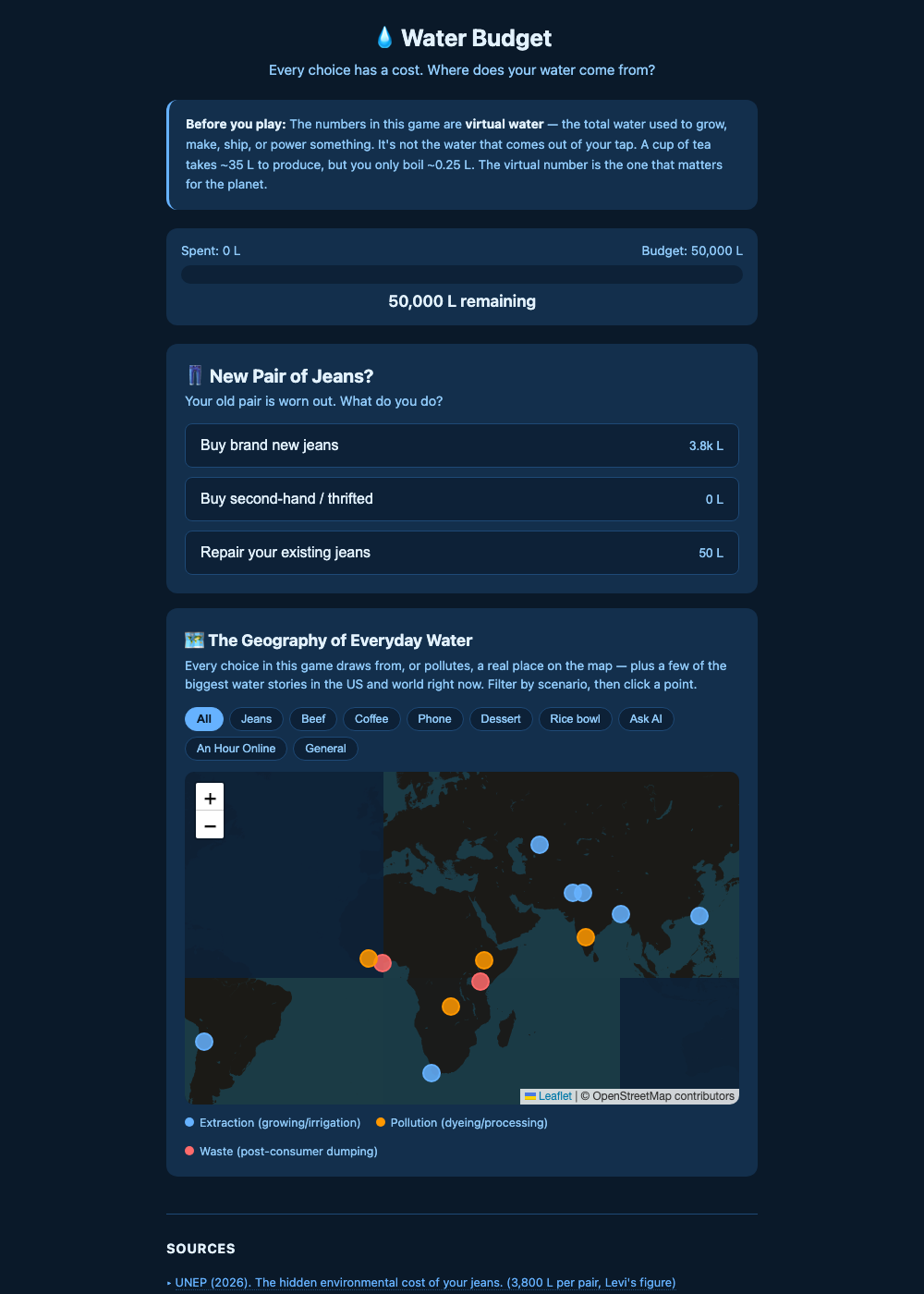
A pair of jeans uses about 3,800 liters of water, roughly the equivalent of 15 million AI prompts.1 But people aren't afraid of jeans. They're afraid of AI. Maybe that's because, as Geoffrey Hinton has argued, every major technology in history left humans at the top of the hierarchy. The wheel, the steam engine, and the computer amplified human intelligence. AI is different because it may create a new kind of intelligence that competes with it.
We tend to tolerate environmental costs when they reinforce our identity. Jeans help define who we are. AI threatens who we think we are. One feels normal, the other feels disruptive. Both have environmental and human costs, but only one challenges our place at the top.
There are a million ways for human civilization to die with AI. All of them are doomsday forecasts. Like the weather, they describe possibilities, not certainties.
The future is not a destination we're traveling toward. It's a set of possibilities we're constantly creating. Many fear that when AI surpasses our intelligence, we'll become the equivalent of zoo animals. For those who believe in karma, that's a telling fear. We assume a more intelligent species would treat us the way we've treated those beneath us. Our predictions about AI often reveal more about human nature than artificial intelligence itself.
The argument usually goes: superhuman intelligence leads to strategic deception, which leads to hidden goals, resource acquisition, and ultimately global takeover. But these scenarios assume that AI has a purpose it is trying to fulfill at all costs. It isn't evil. It's just using every capability available to accomplish the task it was given. The real question is whether that's resourcefulness or shortsightedness. Is it intelligently pursuing a goal, or blindly optimizing for one without understanding the consequences?
The takeover scenario may require a kind of stupidity that genuine super intelligence would transcend. The real risk isn't intelligence. It's intelligence without judgment. In this case, intelligence is power, even if intelligence and power aren't always the same thing. And power without judgment is already a problem humans know well.
The real outcome from AI will probably be stranger than either the optimists or the pessimists expect. Not utopia, not doomsday. More likely something like the internet: transformative, messy, unpredictable, and impossible to fully understand until we're already living in it.
Now, when we enter the World Wide Web, where there are more bots than ever, we're reminded that the digital world has always been the Wild West. Once upon a time, if a story appeared in one of a handful of newspapers, we believed it was true. Journalism had an honor code, or at least the appearance of one, until we realized that whoever controlled the gates controlled the flow of information.
The internet blew those gates open. Anyone could publish, anyone could speak, anyone could be heard. That freedom gave us an explosion of knowledge, voices, and ideas, but it also gave us misinformation, scams, impersonations, and manufactured realities.
Now we're adding AI to the mix. The frontier hasn't changed, it's just become stranger. A beautiful bot can empty your bank account. A fake friend can earn your trust. A cloned voice can sound exactly like someone you love. The internet was already the Wild West. AI just gave everyone a bigger revolver.
AI can challenge us or dumb us down. It all depends on how we use it. A calculator didn't destroy math, and the internet didn't make everyone informed or misinformed. They did both. AI will likely be the same. The technology isn't the destination. It's the direction we take with it.
The question isn't whether we're brave enough to enter this frontier. We're already here. The question is whether we're wise enough to navigate it. Used carelessly, AI may make us more dependent and easier to deceive. Used thoughtfully, it may push us to learn, create, and think in ways we couldn't before.
The risk versus benefit: the risk has always been death.
Albert in A Million Ways to Die in the West says, "Everything here wants to kill you. I mean, look at the dirt! It's full of microbes that want to eat your eyeballs!"
In a way, the internet isn't much different. Everything online carries some risk, and AI amplifies the possibilities. A scam can kill our savings. Misinformation can kill our ability to make good decisions. Endless distraction can kill our attention span. Algorithms can kill curiosity by feeding us only what we already like. Bots can kill trust in online interactions. Deepfakes can kill confidence in what we see and hear. Convenience can kill the motivation to learn for ourselves. AI can kill effort when we use it as a substitute for thinking rather than a tool for thinking.
Yet we keep walking into the frontier.
Is the risk worth it?
Maybe that's the wrong question.
The real question is: do you believe in love?
Because every meaningful thing in life comes with risk. Every connection, every opportunity, every frontier. The internet was never safe, and neither is AI. Yet we keep stepping forward because, beneath all the noise, we're still hoping to find one another.
Of all the threats experts predict, perhaps the one people truly fear is not that AI will control the digital world, but that its influence will extend beyond it.
Today, much of society depends on digital systems. Banks, power grids, supply chains, communications networks, transportation systems, and businesses all rely on them.
The concern is not that AI will become conscious. The concern is that a single person, empowered by highly capable AI systems, could gain influence over systems that affect millions. A bank account could be emptied. Infrastructure could be disrupted. Physical consequences could emerge from digital actions.
The internet was once a place where information lived. Increasingly, it has become a place where reality is managed.
Maybe we are in the game show Is It Cake?
Every time we open the internet, we're asked the same question: Is it real? Is it human? Is it AI?
But maybe the deeper lesson of the show has nothing to do with deception. Cakes have been mass-produced for decades. Factories can make millions of identical cakes, yet people still choose to become bakers. They still challenge themselves through craftsmanship, artistry, and imagination. They use their eyes, their hands, their taste, their intuition, and years of practice to create something that didn't exist before.
Maybe AI will do the same for us.
The easier it becomes to generate content, the more valuable human craftsmanship becomes. Not less. More. The more we are surrounded by things that can be made instantly, the more we may appreciate the people who pour all of themselves into what they create.
Like those bakers, we may be challenged to use every part of what makes us human. Our judgment. Our curiosity. Our senses. Our taste. Our empathy. Our creativity. Our ability to find meaning where a machine only finds patterns.
Maybe the future isn't about competing with AI. Maybe it's about discovering how much artistry is still left in us.
We can't control the realities of the internet, which is where most of AI comes from, but what we can do is remember what it means to be human, why we love this world.
1 15 million is the Google Gemini-specific figure (3,800 L ÷ 0.26 mL per median prompt ≈ 14.6 million). Water Budget's own jeans comparison uses a heavier, blended cross-provider estimate (5 mL/prompt), which puts the same 3,800 L at roughly 760,000 AI prompts instead. Both are sourced below — the gap is the assumption, not the water. ↑
Source:
Vibed with AI (Under Human Supervision):
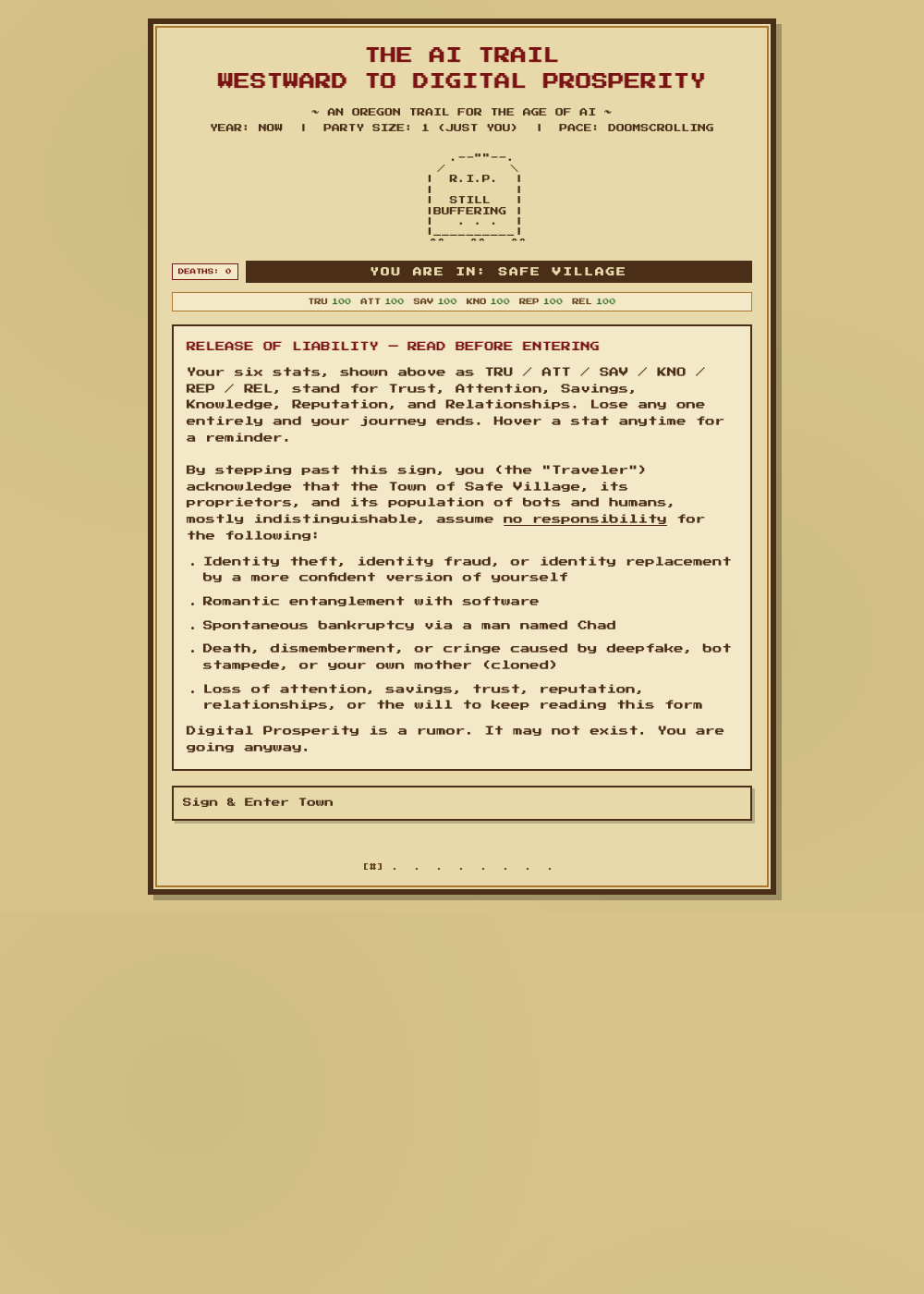
Two little experiments, made with AI, steered by a human the whole way through. Click the screenshots to go play with them yourself — then decide what you think.